All Categories
Featured
Table of Contents
- – Harmony SoCal Insurance Services
- – What Is Payroll Integration for Employee Benef...
- – How Payroll Integration Differs from Manual P...
- – Key Data Flows in Integration
- – Common Systems Involved
- – Why It Matters for Modern Businesses
- – Why Integrate Payroll with Employee Benefits T...
- – Time and Cost Savings Explained
- – Quantified Hours Saved Annually
- – Building Employee Trust Through Accuracy
- – How Does Payroll Integration Work Step by Step?
- – Setup and Onboarding Basics
- – Compatibility with Popular Payroll Platforms
- – Handling Changes and Updates
- – Key Benefits of Payroll Integration Employee B...
- – Administrative Efficiency Gains
- – Reduced Manual Entry Risks
- – Streamlined Open Enrollment
- – Enhanced Compliance and Security
- – ACA/COBRA Alignment
- – Payroll Integration vs Manual Benefits Adminis...
- – Accuracy and Error Metrics
- – Real-World Reduction Percentages
- – Scalability for Growing Teams
- – Employee Experience Impact
- – Common Challenges and Solutions in Payroll Int...
- – Compatibility and Implementation Hurdles
- – Best Practices for Smooth Onboarding
- – Compliance Risks in Changing Regulations
- – Monitoring and Update Application
- – Trends and Best Practices for Payroll Integration
- – Emerging Automation Features
- – Dynamic Deductions Management
- – Focus on Employee Financial Wellness
- – Payroll Integration for Retirement and Volunta...
- – Automating Contributions and Eligibility
- – Timely Deposits and Compliance
- – Voluntary Benefits Deduction Sync
- – Ready to Streamline Your Payroll Integration E...
- – We Can Help! Contact Us Today
- – Frequently Asked Questions About Payroll Integ...
- – Harmony SoCal Insurance Services
Harmony SoCal Insurance Services
2135 N Pami Circle Orange, CA 92867(714) 922-0043
Harmony SoCal Insurance Services
Payroll integration employee benefits connects payroll systems directly to benefits administration platforms, automating the handling of deductions, contributions, and eligibility data for group health insurance, dental coverage, vision plans, retirement options, and voluntary benefits. This automated connection eliminates repeated manual transfers, double entry work, and time-wasting record matching that frequently result in inaccuracies and delays. Employers obtain immediate insight into benefit expenses and enrollment levels, while employees receive consistent, error-free paychecks and benefit processing that builds greater trust in their selected benefits.
A large number of business leaders deal with recurring issues when payroll and benefits function independently. Modifications to enrollment, pay changes, or qualifying life events require multiple manual steps in isolated platforms, creating administrative bottlenecks, increasing error potential, and diverting valuable time. How does payroll integration work to resolve these persistent issues? Through safe bidirectional synchronization, the system automatically adjusts payroll computations to match current benefit choices without repeated manual input across platforms. This delivers greater accuracy, major time savings, and better synchronization between employer offerings and employee expectations. The method completely accommodates broad group benefits offerings including additional health coverage, wellness programs, and retirement plan management, addressing the growing need for optimized, low-error benefit administration that boosts enrollment and employee contentment.
What Is Payroll Integration for Employee Benefits?
Payroll integration employee benefits establishes a direct, automated link between payroll processing and employee benefits systems, enabling seamless synchronization of employee information for accurate deduction calculations, contribution processing, and continuous eligibility verification. Rather than relying on manual file transfers, separate spreadsheets, or repeated data entry, information such as wages, hours, employment status, and benefit elections flows instantly across connected systems. This cohesive operation replaces scattered administrative steps and covers key areas such as medical plan premiums, automatic retirement funding, and supplemental benefit deductions.
The fundamental benefit emerges from establishing one authoritative source of employee records. When an employee adds a new benefit, modifies existing coverage, or has a qualifying event occur, the change updates immediately throughout connected platforms, removing chances of record discrepancies that lead to wrong pay statements, postponed benefit activation, or regulatory breaches. What is payroll integration employee benefits in daily organizational practice? It redefines HR administrative duties by allowing teams to record details once and achieve consistent accurate distribution across payroll processing and benefits management. This supports all aspects from simple medical deductions to advanced retirement synchronization, including matching retirement contributions and optional supplemental coverage.
Organizations achieve enhanced visibility into participation trends and related expenses, enabling smarter plan choices about coverage offerings and carrier relationships. Extensive compatibility with popular payroll platforms reduces implementation barriers, while sophisticated security protocols safeguard sensitive information during every data exchange. The overall transformation moves administration from reactive mistake fixing to preventive operational excellence, delivering clear enhancements in process effectiveness and workforce contentment. For more insights into business protection strategies, explore our business owners insurance overview.
How Payroll Integration Differs from Manual Processes
Traditional manual methods depend on separate systems, multiple manual inputs, and scheduled file transfers, creating numerous opportunities for inconsistencies, transcription errors, and timing discrepancies. Payroll integration employee benefits completely transforms this approach by implementing continuous syncing, checking, and refreshing, achieving steady accuracy and major reduction in administrative interventions. The move from disconnected to unified systems eradicates duplicate validation and significantly lowers error likelihood that frequently impacts separate platforms.
Key Data Flows in Integration
Information flows two-way instantly: payroll sends compensation and employment status data while benefits platforms supply latest deduction figures and eligibility information. This constant two-way communication ensures deductions and contributions remain synchronized with the latest enrollment information. The systematic synchronization enables accurate processing of intricate situations including mid-cycle modifications and qualifying life events.
Common Systems Involved
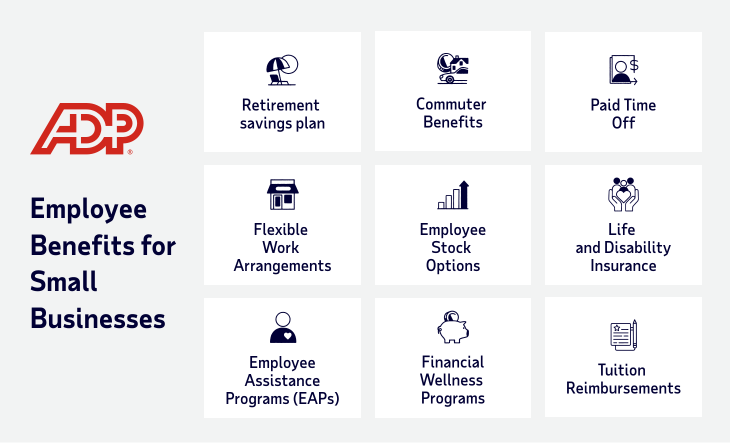
Common setups link established payroll providers to benefits administration solutions that support group health, dental, vision, and retirement offerings. Payroll integration employee benefits accommodates various configurations, delivering versatility for businesses using established systems. Compatibility across providers simplifies deployment irrespective of organization scale or sector.
Why It Matters for Modern Businesses
Today's organizations encounter growing intricacy in employee benefits and regulatory demands. Payroll integration employee benefits provides the technological foundation needed to handle growing intricacy without corresponding administrative expansion. The capability delivers scalability, accuracy, and visibility critical for sustaining attractive benefit offerings while controlling operational costs.
This foundation establishes immediate operational efficiency. Contact us for a no-cost assessment to evaluate potential integration benefits specific to your organization.
Why Integrate Payroll with Employee Benefits Today?
Fragmented payroll and benefits systems generate persistent operational friction that compounds over time. Manual reconciliation, repeated data entry, and separate processing workflows consume significant resources while creating preventable mistakes and compliance risks. Why integrate payroll with employee benefits emerges as a critical business decision when examining the cumulative effects on performance, monetary correctness, and staff dynamics. Automation eliminates repetitive administrative tasks, allowing teams to redirect energy toward strategic initiatives rather than ongoing checking and fixing routines.
Time savings emerge as one of the clearest gains. Businesses consistently save 50 to 100 hours yearly by avoiding hand-operated management of deduction adjustments, contribution calculations, and eligibility updates, according to administrative efficiency studies from respected payroll authorities. This saved capacity supports allocation to growth-oriented initiatives or better employee assistance programs without demanding more headcount. Error frequency drops substantially, typically reaching 70–90% reductions, via continuous automatic verification that avoids input errors, timing issues, and overlooked modifications. Adherence capabilities advance significantly. Requirements for documentation, deposit schedules, and eligibility determination receive continuous monitoring and automatic application of updates, greatly lowering penalty risks that may build rapidly when manual processes fall behind updated requirements.
Staff perception improves noticeably as well. Consistent paycheck accuracy and dependable benefit delivery enhance belief in company benefit management. Stronger confidence associates with higher voluntary benefit enrollment and improved overall satisfaction scores. Growth capacity stands out as a key benefit for companies facing growth phases or cyclical changes. Integrated systems accommodate expanded headcount, additional benefit options, or changing participation patterns without proportional admin growth, preserving efficiency during periods of transition. These combined improvements deliver both immediate emotional relief from persistent administrative stress and lasting rational benefits like cost management, risk avoidance, and workflow resilience. For additional business protection considerations, review our business financing solutions. Contact us to examine how integration aligns with your specific operational requirements.
Time and Cost Savings Explained
Time reclamation leads directly to quantifiable cost decreases by lowering staff hours allocated to standard validation and correction work. Payroll integration employee benefits removes redundant data handling steps, facilitating improved allocation of personnel resources. Cost benefits build progressively as overhead stabilizes or reduces while functional capability expands.
Quantified Hours Saved Annually
Annual time savings frequently range from 50 to 100 hours through avoidance of manual deduction changes, reconciliation work, and error fixing. This time-saving advance permits redirection of employees to strategic functions. Benefits grow progressively larger as organization size or benefits complexity grows.
Building Employee Trust Through Accuracy
Dependable correctness in payroll execution and coverage delivery immediately builds staff trust in company processes. Payroll integration employee benefits ensures deductions align precisely with elections and deposits occur consistently on schedule. This consistency results in greater involvement and better impression of company dedication to employee financial health.
Benefits build quickly across several key areas. Reach out for customized assessment of potential improvements in your environment.
How Does Payroll Integration Work Step by Step?
The implementation process begins by creating protected links between current payroll systems and benefits management tools. Initial synchronization transfers core employee census information including pay information, job standing, start dates, and active benefit selections to form unified starting records. Later modifications to coverage, pay changes, or life-event triggers automatically propagate through the connected systems without demanding additional hand-entry at various stages.
Implementation includes thorough field alignment, setup of data conversion logic, and extensive validation stages to confirm correctness in all situations. Following successful confirmation, active operations commence with negligible disruption. During regular processing cycles, payroll obtains current deduction rates and coverage eligibility, performs precise calculations, and securely transmits deduction and contribution information for final execution. Bidirectional flow ensures data consistency by confirming successful processing on both sides and identifying irregularities for quick correction.
Compatibility across popular payroll providers greatly eases implementation, while embedded monitoring functions identify and resolve discrepancies early. The entire workflow evolves into a dependable, low-maintenance process that steadily produces precise outcomes. For related operational insights, see our process overview. Contact us for specific guidance regarding your current technology environment and integration possibilities.
Setup and Onboarding Basics
Setup concentrates on establishing secure connections and validating initial data alignment. Payroll integration employee benefits implementation includes organized validation procedures to confirm operational accuracy before full deployment. This detailed readiness period lowers exposure during implementation to automated workflows.
Compatibility with Popular Payroll Platforms
Support covers leading payroll systems widely adopted in various sectors. Payroll integration employee benefits works with multiple platform combinations, reducing technical barriers for organizations with established systems. Wide compatibility facilitates successful deployment regardless of existing technology choices.
Handling Changes and Updates
situational adjustments such as new enrollments, plan changes, or status modifications synchronize automatically upon occurrence. Payroll integration employee benefits maintains data accuracy throughout dynamic periods. This feature demonstrates necessity for businesses with ongoing employee changes or benefit updates.
The setup approach delivers trustworthy, reproducible results. Contact us for specialized support in mapping your specific requirements to optimal integration strategies.
Key Benefits of Payroll Integration Employee Benefits
Payroll integration employee benefits produces substantial operational improvements through structured automation and ongoing information accuracy. Administrative demands decrease markedly as standard checking, input, and matching activities no longer require attention. Staff reallocate focus to strategic priorities rather than ongoing correction cycles, creating capacity for innovation and improved service delivery.
Error reduction stands as one of the most impactful advantages. Systematic checking eliminates several frequent inaccuracy sources including input mistakes, timing inconsistencies, and forgotten changes. Businesses often achieve significant drops in inaccuracy occurrence, frequently reaching 70–90% according to administrative performance research. This consistency guards against direct rework costs and secondary costs from regulatory breaches or staff discontent caused by administration errors.
Compliance posture advances significantly. Platforms constantly track relevant rules and instantly apply necessary modifications for reporting, deposit timing, and eligibility determination. This forward-looking approach greatly lowers fine risks that can accumulate quickly when hand-operated monitoring lags changing regulations. Staff experience enhances considerably through dependable paycheck accuracy and seamless benefit access. Trust in handling procedures promotes higher engagement in available plans and contributes positively to overall satisfaction metrics.
Cost containment follows naturally from decreased administrative labor requirements and fewer error-related expenses. Correct records facilitate improved benefits budget planning while enhanced transparency supports smarter choices regarding coverage offerings and carrier selection. These interrelated gains build a robust operational framework that supports both immediate efficiency gains and long-term organizational resilience. With deep expertise in group benefits administration, Harmony SoCal Insurance Services supports businesses in obtaining these results through accurate, expandable deployment methods. For additional perspectives on business protection, consider our business owners insurance resources.
Administrative Efficiency Gains
Workflow efficiency rises considerably as duplicate information processing vanishes from regular operations. Payroll integration employee benefits optimizes open enrollment processes through automated eligibility verification and deduction setup. Cycle duration shortens significantly while correctness advances, permitting teams to process increased numbers without corresponding resource increases.
Reduced Manual Entry Risks
Manual data entry hazards reduce substantially with automatic information movement. Payroll integration employee benefits avoids input errors and processing timing issues that commonly happen in disconnected platform updates. Consistent automated validation maintains high accuracy standards across all processing cycles.
Streamlined Open Enrollment
Open enrollment periods become significantly more manageable with instant eligibility verification and deduction computation. Payroll integration employee benefits reduces employee confusion and administrative workload during high-volume periods. Greater plan participation commonly follows from the streamlined interaction.
Enhanced Compliance and Security
Adherence features improve via ongoing rule tracking and proactive change application. Payroll integration employee benefits preserves comprehensive audit documentation that facilitate documentation requirements. Security standards defend private information throughout every transmission and storage point.
ACA/COBRA Alignment
ACA and COBRA mandates experience ongoing monitoring through automatic monitoring and documentation capabilities. Payroll integration employee benefits guarantees prompt alerts and record-keeping for compliance obligations. This structured technique significantly decreases regulatory vulnerability.
These interconnected gains build a robust operational strength. Contact us to discuss implementation possibilities for your organization.
Payroll Integration vs Manual Benefits Administration: A Comparison
Conventional manual management functions via isolated platforms, demanding multiple manual inputs and scheduled file exchanges that create numerous opportunities for inconsistency and oversight. Payroll integration vs manual employee benefits demonstrates fundamental differences in effectiveness, correctness, and expandability that impact daily operations and long-term outcomes. Unified systems carry out automated syncing and calculation operations, substantially reducing handling periods compared to manual verification requirements. Traditional methods necessitate detailed cross-referencing that lengthens processing and elevates tiredness-induced errors.
Accuracy improves significantly under automation as integrated verification happens continuously at each information transfer. Hand-operated methods stay vulnerable to human inconsistency that introduces inconsistency even with careful oversight. Scalability represents another decisive advantage for connected systems. Platforms handle company expansion, new benefit additions, or varying enrollment without proportional admin growth. Manual processes quickly become strained under similar conditions, demanding corresponding staffing growth that influence costs and process adaptability. Staff experience differs significantly between approaches: connected processing provides prompt, correct outcomes that reinforce trust, while traditional hold-ups and corrections erode belief and satisfaction. The comparison clearly illustrates superior performance characteristics of integrated administration across multiple dimensions critical to modern business success. For complementary protection strategies, explore our family insurance solutions.
Accuracy and Error Metrics
Precision standards improve significantly with systematic checking capabilities. Payroll integration employee benefits consistently outperforms manual methods in upholding record consistency across workflow repetitions. Reduced variability results in fewer discrepancies requiring resolution.
Real-World Reduction Percentages
Practical applications often reveal considerable inaccuracy reductions through automatic processing. Payroll integration employee benefits limits human supervision vulnerabilities that lead to errors. The resulting reliability translates into measurable operational improvements.
Scalability for Growing Teams
Growth capacity allows companies to grow without workflow pressure. Payroll integration employee benefits maintains processing efficiency during staffing growth or plan expansions. This feature facilitates controlled growth trajectories.
Employee Experience Impact
Employee experience benefits substantially from dependable administration. Payroll integration employee benefits provides steady precision that builds confidence in company procedures. Improved views promote increased participation and retention.
The comparison clearly favors integrated approaches for enduring efficiency. Contact us to review your present payroll-benefits processes against these benchmarks.
Common Challenges and Solutions in Payroll Integration
Integration compatibility issues arise when linking platforms with varying data structures, communication methods, or refresh intervals. Common concerns about payroll integration employee benefits frequently center on perceived difficulty of starting implementation and possible workflow interruptions during implementation stages. Effective solutions center on structured implementation methodologies that feature precise mapping, complete testing cycles, and gradual implementation. Specialized assistance across these steps quickens solution finding while limiting organizational effects.
Data protection and regulatory adherence remain valid concerns when sensitive employee information moves between platforms. Strong encryption protocols, permission management, and ongoing oversight features address these concerns effectively, maintaining protection throughout data transmission and storage. Regulatory vulnerability reduces significantly through automated tracking of changing requirements and proactive application of necessary updates. Numerous businesses achieve smooth implementations by employing recognized best practices and working with skilled integration specialists.
Transition management issues commonly occur with system adoption. Transparent communication plans, focused training initiatives, and continuous assistance assist staff in adjusting rapidly to updated processes. Most companies achieve major improvements quickly after implementation. These results confirm the original commitment through enhanced performance and decreased vulnerability. Harmony SoCal Insurance Services handles these implementations proficiently, creating assurance via compliant, consistent integration delivery. For additional business considerations, review our impaired risk solutions.
Compatibility and Implementation Hurdles
Connection issues address through organized mapping and confirmation methods. Payroll integration employee benefits onboarding emphasizes thorough testing across scenarios. This groundwork assures dependable functioning following launch.
Best Practices for Smooth Onboarding
Recommended approaches include staged rollout and ongoing validation. Payroll integration employee benefits implementations gain from organized strategy and defined checkpoints. This methodology minimizes operational disruption during changeover.
Compliance Risks in Changing Regulations
Regulatory exposure diminishes through forward-looking oversight. Payroll integration employee benefits instantly applies changing regulatory requirements. This organized technique ensures persistent regulatory alignment to obligations.
Monitoring and Update Application
Constant tracking spots regulatory updates immediately. Payroll integration employee benefits implements required changes instantly. This functionality greatly lowers regulatory risk.
These intelligent approaches turn potential obstacles into operational benefits. Contact us for expert assistance in resolving implementation difficulties specific to your organization.
Trends and Best Practices for Payroll Integration
Automation technologies progress steadily with more sophisticated real-time adjustment features and intelligent eligibility verification processes. Payroll integration trends increasingly emphasize connections to employee financial wellness resources, establishing significant ties between benefits processing and educational content that foster greater knowledge and participation in existing plans. Recommended approaches involve setting periodic performance evaluations, keeping detailed configuration records, and establishing forward-looking employee communication plans regarding available plans and modifications.
Prioritizing intuitive user interfaces significantly enhances adoption rates among both administrative staff and plan participants. Attention to complete coverage assures seamless handling of supplemental benefits alongside main offerings, supporting varied staff requirements without added complexity. Companies that implement modern approaches and stay alert to new advancements equip themselves to achieve optimal returns from integration investments over extended periods. For related wellness perspectives, see our wellness program incentives guide.
Emerging Automation Features
Emerging automation incorporates increasingly responsive adjustment capabilities. Payroll integration employee benefits leverages advanced syncing to accommodate dynamic changes. This evolution improves administrative flexibility substantially.
Dynamic Deductions Management
Responsive management addresses changing deduction situations well. Payroll integration employee benefits modifies computations instantly using up-to-date information. This capability supports evolving employee circumstances seamlessly.
Focus on Employee Financial Wellness
Financial education integration ties benefits processing to informational content. Payroll integration employee benefits fosters improved knowledge and participation in plans. This linkage increases perceived benefit worth for employees.
Contemporary methods offer enduring value when implemented thoughtfully. Contact us for actionable advice on adopting these advancements into your benefits strategy.
Payroll Integration for Retirement and Voluntary Benefits
Retirement plan handling improves significantly from systematic syncing functions. 401k payroll integration calculates contribution amounts based on current compensation data and transmits deposits according to required schedules with reduced manual supervision. Voluntary coverage gets comparable exactness in administration, with deductions processed correctly for plans such as accident coverage, critical illness protection, and additional life insurance. Eligibility verification occurs instantly upon enrollment or modification, ensuring appropriate coverage activation without delay.
This dependable performance allows organizations to provide broader retirement and voluntary offerings while maintaining administrative simplicity. Staff develop trust knowing selected coverage processes accurately and contributions accumulate as intended. The method effectively balances robust plan offerings with manageable oversight requirements. Harmony SoCal Insurance Services provides focused knowledge in these integration domains, delivering reliable, satisfaction-assured outcomes in precision and workflow efficiency. For complementary protection options, explore our critical illness riders guide.
Automating Contributions and Eligibility
Automatic contributions stem from present eligibility and pay data. Payroll integration employee benefits guarantees accurate computation and delivery of retirement contributions. This feature preserves compliance with deposit regulations.
Timely Deposits and Compliance
On-schedule deposit handling promotes extended retirement success. Payroll integration employee benefits - Aliso Viejo Payroll Service For Small Business matches deposits to required schedules dependably. This consistency lowers compliance risk considerably
Voluntary Benefits Deduction Sync
Deduction syncing applies to elective benefit options. Payroll integration employee benefits applies accurate amounts for accident and supplemental plans. This accuracy promotes wider engagement with offered benefits.
The approach enhances employee financial security and employer management efficiency. Contact us to review integration methods for retirement and voluntary benefit integration.
Ready to Streamline Your Payroll Integration Employee Benefits?
Administrative complexity from disconnected payroll and benefits systems continues draining organizational resources while producing continual irritation among employees. Payroll integration employee benefits near you resolves these challenges by delivering automatic accuracy, integrated compliance protection, and significantly streamlined processes. Actual client experiences repeatedly demonstrate game-changing results: one Southern California business owner reported a 40 percent reduction in administrative time after implementation, describing the change as "completely liberating for focusing on strategic priorities and team development." Another client emphasized restored employee confidence, noting that "consistent deductions and dependable handling removed prior issues and noticeably enhanced team morale."
A third organization highlighted compliance peace of mind, stating that "automatic regulatory updates removed the constant worry about missing deadlines or misinterpreting requirements". These experiences reflect typical outcomes when transitioning from manual to automated processing. Implementation complexity concerns generally fade fast with structured support, comprehensive testing, and compatibility assurance. The change provides fast returns through decreased labor expenses, minimized correction costs, and better employee contentment levels. A modest initial commitment unlocks substantial long-term advantages across workflow performance and business durability. Contact us for a no-cost assessment to uncover particular efficiency opportunities within your current environment.
We Can Help! Contact Us Today
Imagine compensation processing functioning with perfect consistency: deductions processed accurately, contributions forwarded per timeline, regulatory obligations met automatically, and your administrative team freed to concentrate on strategic priorities rather than endless checking of routine details. Payroll integration employee benefits delivers this workflow excellence through instant operational gains, risk-free precision, and expandable capacity that scales with your business. Relief arrives from eliminating persistent oversight of administrative details that previously consumed excessive time and energy. Safety advances markedly with trustworthy, documented procedures that minimize compliance exposure. Confidence develops naturally from consistently reliable outcomes that align with expectations across all stakeholders. Peace of mind emerges when knowing potential risks remain effectively controlled through structured automation and continuous oversight.
Rational reasons for implementation encompass significant time reclaimed for value-adding activities, demonstrable cost decreases from reduced rework and avoided penalties, improved precision that actively promotes staff retention and contentment, expandability that supports company growth without workflow burden, and complete regulatory safeguards that avoid compliance issues. Investment return appears clearly in efficient operations, decreased financial waste, and enhanced organizational resilience. Harmony SoCal Insurance Services, 2135 N Pami Cir, Orange, CA 92867, (714) 922-0043, maintains expertise in delivering these outcomes through integrated payroll employee benefits, voluntary plan management, retirement coordination, and related insurance offerings. With more than ten years of specialized experience, relevant certifications, and an unwavering satisfaction guarantee, the organization steadily produces reliable, value-creating results for businesses across different fields and organization sizes.
If you're pursuing professional payroll integration employee benefits solutions in California, Harmony SoCal Insurance Services provides dependable collaboration centered on efficient deployment and ongoing excellence. Experienced professionals focus on providing precise, effective solutions customized to unique business needs. Whether running a startup, mid-market business, or large enterprise, the team helps different businesses with exactness and thorough attention. Conveniently positioned in Southern California, services extend efficiently throughout the region. Aliso Viejo Payroll Service For Small Business. Schedule a complimentary consultation to receive a personalized assessment and estimate. Demonstrated knowledge paired with satisfaction assurance guarantees your benefits management reaches peak effectiveness. Permit us to elevate your performance with confidence and quantifiable advancement!
Frequently Asked Questions About Payroll Integration Employee Benefits
What is payroll integration employee benefits?
Payroll integration employee benefits creates automatic links between payroll and benefits platforms for precise handling of deductions, contributions, and eligibility. Instant information syncing removes manual file exchanges, minimizing mistakes and processing delays. This facilitates precise administration of group health, retirement accounts, dental, vision, and voluntary plans. Organizations gain single-source records while employees experience consistent paycheck precision. The approach creates operational efficiency and strengthens trust through consistent administration. For more details on related solutions, see our main services overview.
How does payroll integration reduce errors?
Automatic processing removes manual data input locations where transcription mistakes commonly occur. Tools confirm data consistency during alignment, identifying inconsistencies immediately. This method substantially reduces error rates compared to disconnected traditional methods. Compliance checks run continuously, avoiding lapses in documentation or timelines. Overall, the reduction in human intervention results in more dependable outcomes and fewer costly corrections. Learn more about accuracy benefits in our facts and insights page.
What are the benefits of payroll integration for small businesses?
Small businesses recover significant administrative time previously dedicated to manual adjustments and verifications. Accuracy improvement safeguards constrained budgets from surprise fixing costs. Compliance management becomes straightforward without continuous monitoring. Correct administration boosts employee morale and supports retention efforts. Growth capacity handles expansion without matching admin increases. Explore small business options through our business owners insurance guide.
Does payroll integration ensure compliance?
Connected systems instantly apply changing rules and keep thorough compliance documentation. They address documentation deadlines, eligibility checking, and deposit obligations forward-lookingly. This systematic approach minimizes compliance risks and penalty exposure. Consistent data management supports accurate regulatory filings. For compliance-related insights, visit our about page.
How to choose payroll integration for employee benefits?
Review compatibility with present payroll platforms, protection levels, setup difficulty, and continued assistance quality. Examine support for particular benefit categories such as retirement and supplemental plans. Assess growth capacity for upcoming business expansion. Expert guidance helps align features with business requirements. Review selection criteria in our process explanation.
Does payroll integration work with 401(k) plans?
Systematic integration determines contributions from current earnings and ensures timely transmission according to regulatory schedules. Eligibility changes align right away, maintaining compliance with deposit requirements. This accuracy enables reliable retirement accumulation. See related retirement considerations in our senior insurance resources.
What time savings can I expect from payroll integration?
Many companies save 50 to 100 admin hours each year through removal of hand-operated matching and checking activities. Handling cycles compress dramatically, permitting personnel reallocation to strategic initiatives. These productivity improvements grow more substantial with organizational scale. Additional efficiency insights available on our facts page.
Payroll integration employee benefits near you—how do local experts help?
Local specialists provide personalized implementation support and prompt continuing support adapted to local business environments. They deliver swift problem-solving and direction tailored to local compliance needs. This proximity enables more effective collaboration and faster results. Discover local service advantages through our contact page.
Is payroll integration worth it for growing teams?
Automatic processing shows obvious benefits by managing increased transaction volume without corresponding administrative increases. Scalability preserves processing efficiency during organizational expansion phases. Additional plan options incorporate smoothly without process interruption. Growth-related solutions discussed in our business financing guide.
How does payroll integration support voluntary benefits?
Supplemental plan deductions handle automatically with instant eligibility verification for options such as accident protection and critical illness coverage. Precise processing promotes wider engagement through streamlined processing. Dependable processing improves staff view of offered benefits. Explore voluntary benefit details in our accident insurance overview.
Harmony SoCal Insurance Services
Address: 2135 N Pami Circle Orange, CA 92867Phone: (714) 922-0043
Email: [email protected]
Harmony SoCal Insurance Services
Payroll Service Small Business Aliso Viejo, CA
Payroll Service Provider Aliso Viejo, CA
Employee Benefits Management Solutions Aliso Viejo, CA
Employee Benefits Center Aliso Viejo, CA
Employee Benefits Consulting Aliso Viejo, CA
Payroll Service Providers Aliso Viejo, CA
Local Payroll Services Aliso Viejo, CA
Payroll Service For Small Business Aliso Viejo, CA
Payroll Service Provider Aliso Viejo, CA
Employee Benefits Consulting Aliso Viejo, CA
Employee Benefits Consulting Aliso Viejo, CA
Payroll Services Small Business Aliso Viejo, CA
Payroll Service Provider Aliso Viejo, CA
Payroll And Services Aliso Viejo, CA
Employee Benefits Management Solutions Aliso Viejo, CA
Employee Benefits Insurance Agency Aliso Viejo, CA
Employee Benefits Broker Near Me Aliso Viejo, CA
Payroll Services Small Business Aliso Viejo, CA
Payroll Service Small Business Aliso Viejo, CA
Employee Benefits Broker Near Me Aliso Viejo, CA
Employee Benefits Consulting Firms Aliso Viejo, CA
Payroll Service Small Business Aliso Viejo, CA
Employee Benefits Solutions Aliso Viejo, CA
Employee Benefits Company Aliso Viejo, CA
Payroll Service Provider Aliso Viejo, CA
Payroll Service For Small Businesses Aliso Viejo, CA
Employee Benefits Outsourcing Companies Aliso Viejo, CA
Payroll And Services Aliso Viejo, CA
Payroll Service For Small Businesses Aliso Viejo, CA
Church Payroll Services Aliso Viejo, CA
Close By Seo Services For Small Business Aliso Viejo, CA
Finding A Good Local Seo Optimization Aliso Viejo, CA
Harmony SoCal Insurance Services
Employee Benefits Consulting Firms Aliso Viejo, CA
Employee Benefits Consultants Aliso Viejo, CA

Table of Contents
- – Harmony SoCal Insurance Services
- – What Is Payroll Integration for Employee Benef...
- – How Payroll Integration Differs from Manual P...
- – Key Data Flows in Integration
- – Common Systems Involved
- – Why It Matters for Modern Businesses
- – Why Integrate Payroll with Employee Benefits T...
- – Time and Cost Savings Explained
- – Quantified Hours Saved Annually
- – Building Employee Trust Through Accuracy
- – How Does Payroll Integration Work Step by Step?
- – Setup and Onboarding Basics
- – Compatibility with Popular Payroll Platforms
- – Handling Changes and Updates
- – Key Benefits of Payroll Integration Employee B...
- – Administrative Efficiency Gains
- – Reduced Manual Entry Risks
- – Streamlined Open Enrollment
- – Enhanced Compliance and Security
- – ACA/COBRA Alignment
- – Payroll Integration vs Manual Benefits Adminis...
- – Accuracy and Error Metrics
- – Real-World Reduction Percentages
- – Scalability for Growing Teams
- – Employee Experience Impact
- – Common Challenges and Solutions in Payroll Int...
- – Compatibility and Implementation Hurdles
- – Best Practices for Smooth Onboarding
- – Compliance Risks in Changing Regulations
- – Monitoring and Update Application
- – Trends and Best Practices for Payroll Integration
- – Emerging Automation Features
- – Dynamic Deductions Management
- – Focus on Employee Financial Wellness
- – Payroll Integration for Retirement and Volunta...
- – Automating Contributions and Eligibility
- – Timely Deposits and Compliance
- – Voluntary Benefits Deduction Sync
- – Ready to Streamline Your Payroll Integration E...
- – We Can Help! Contact Us Today
- – Frequently Asked Questions About Payroll Integ...
- – Harmony SoCal Insurance Services
Latest Posts
Web Design San Dimas
Web Design And Development Services Norco
Business Marketing Internet Placentia
More
Latest Posts
Web Design San Dimas
Web Design And Development Services Norco
Business Marketing Internet Placentia